How Positive Thinking Sometimes Increases Anxiety
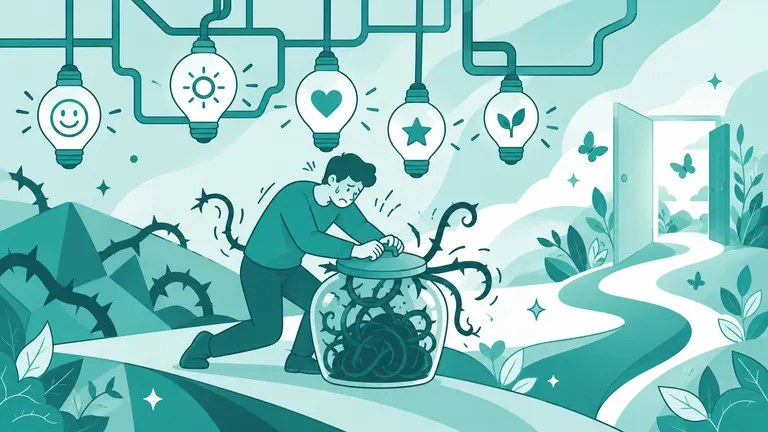
Introduction: The Cult of Good Vibes
"Think positive," "everything will be fine," "don't overthink it"—we hear these phrases everywhere, from caring friends to social media coaches. Positive thinking has turned into almost a social norm: feeling anxious feels embarrassing, while radiating positivity is considered the "right" way to be.
The problem is that for many people, this pressure backfires. Instead of relief, it leads to increased anxiety, guilt, and a sense of internal failure. In this article, we’ll explore why this happens, what research psychology says about it, and how to actually help yourself when dealing with anxiety.
The Paradoxical Effect of Thought Suppression
Let's start with a simple experiment you can conduct right now.
Grab a pen and a blank sheet of paper. Set a timer on your phone for a minute and a half. During these 90 seconds, think about white bears. Only about white bears. You can imagine the word or pictures—whatever works for you—as long as white bears are the main characters of your thoughts for a minute and a half. Every time any other thought pops into your head, draw a plus sign (+) on the paper. Once you're done, come back here.
Done?
Now set the timer for another minute and a half and draw a line under the plus signs you've just made. This time, think about whatever you want, but under no circumstances should you think about white bears—neither as a word nor as an image. If you do catch yourself thinking of one, draw another plus sign (+). Return when the time is up.
Has a minute and a half passed?
Now ask yourself: what was easier? Thinking about white bears, or trying not to think about them? How many plus signs did you write in the first task versus the second?
Chances are, you noticed that trying not to think about them was much harder. This is the exact conclusion Daniel Wegner reached with his famous "White Bear" experiment in 1987. The experiment clearly demonstrated: attempting to suppress a thought causes it to intensify and recur more frequently. This is known as the ironic process theory.
In practice, positive thinking often translates to: "Replace the anxious thought with a good one; don't think about the bad stuff." But the human brain doesn't work so linearly. To check whether you are thinking about a negative outcome, part of your mind must periodically check in on that very "forbidden" thought—a form of background monitoring.
Here is another example: consider someone who is terrified of cats. If you put them in a room with a cat and they can't leave, what will they do? They will constantly scan the room with their eyes to keep the cat in sight and stay in control. Even if you try to distract them with conversation, they will jump at every movement.
It works the exact same way with anxious thoughts we try to push down in hopes that they will vanish on their own. How is the brain supposed to know if the thought is gone if it stops tracking it? As a result:
- The anxious thought doesn't disappear; it recurs more often, and we react to it more intensely.
- Secondary anxiety builds up: "Why am I still thinking about this when I'm trying so hard not to?"
- A sense of losing control over one's own mind emerges.
Positivity as Avoidance, Not Processing
Cognitive Behavioral Therapy (CBT) makes a clear distinction between processing an emotion and avoiding it.
A healthy approach to managing anxiety involves:
- Identifying the emotion and its trigger.
- Assessing the realistic level of threat.
- Developing an action plan or accepting the uncertainty.
Forced positivity often skips the first two steps, immediately swapping anxiety for a "good thought." This leads to avoiding the problem and the negative feeling, but it doesn't make the negativity go away. Everything you experience leaves a mark that your brain needs to "digest" to integrate the experience into its system. Ultimately, ignored emotions find their way out through intrusive thoughts, nightmares, burnout, and heightened long-term anxiety.
Acceptance and Commitment Therapy (ACT) is particularly effective here because it gives your mind space to build psychological flexibility rather than fight what's inside. Yes, this means facing pain head-on, but the difference is immense! Imagine stretching a rubber band wrapped around your finger—the further you pull it, the harder it snaps back. The tension is your avoidance; the less tension there is, the gentler the process of accepting your true feelings becomes.
When Positivity Hurts: Clinical Context
Research shows that forced optimism is especially counterproductive for individuals with:
- Generalized Anxiety Disorder (GAD): Where the attempt to "gain control" over thoughts paradoxically fuels rumination (compulsive overthinking).
- Depression: Studies indicate that for people with low self-esteem, positive affirmations ("I am attractive and worthy") can actually worsen their mood because they conflict with their core beliefs about themselves. The brain perceives the statement as false, deepening the internal conflict.
- Perfectionism: Positive thinking becomes yet another standard to live up to, and failing to meet that standard is a classic anxiety trigger.
How to Truly Help Yourself
- Name the emotion. Describe what you are feeling in plain words. Research by Matthew Lieberman using fMRI showed that simply labeling an emotion ("I am feeling anxious right now") reduces activity in the amygdala—the brain's fear and anxiety center.
- Radical acceptance over self-persuasion. Instead of "I shouldn't feel anxious," try "I am feeling anxious right now, and that is an understandable response to uncertainty."
- Realistic optimism, not rose-colored glasses. Instead of "everything will be great," reframe it as "I don't know how things will turn out, but I have a plan if difficulties arise." This reduces uncertainty through preparation.
- Make room for bad days. Giving yourself permission to not be okay reduces secondary anxiety ("anxiety about anxiety") and paradoxically speeds up the natural fading of the original emotion.
Conclusion
Positive thinking is neither universally harmful nor universally helpful; it all depends on whether it replaces emotional processing or accompanies it. When positivity is used as a ban on negative feelings, it triggers thought suppression, emotional dissonance, avoidance, and secondary guilt—ultimately worsening anxiety rather than relieving it.
True psychological resilience isn't built on the absence of anxiety, but on the ability to acknowledge it, name it, and act despite it. Sometimes, the most "positive" thing you can do for yourself is to give yourself permission not to be positive right now.